
A look at the collaborations that marked the end of Takahiro Miyashita’s original era
The relationship between Number Nine and Converse did not begin as a typical fashion partnership. It began with Takahiro Miyashita’s own history. He grew up wearing Converse, and that early familiarity stayed with him throughout his life as a designer. When Number Nine rose to global attention in the early two thousands, Miyashita carried that childhood memory with him, which is why every Converse collaboration from the archive feels personal rather than corporate.


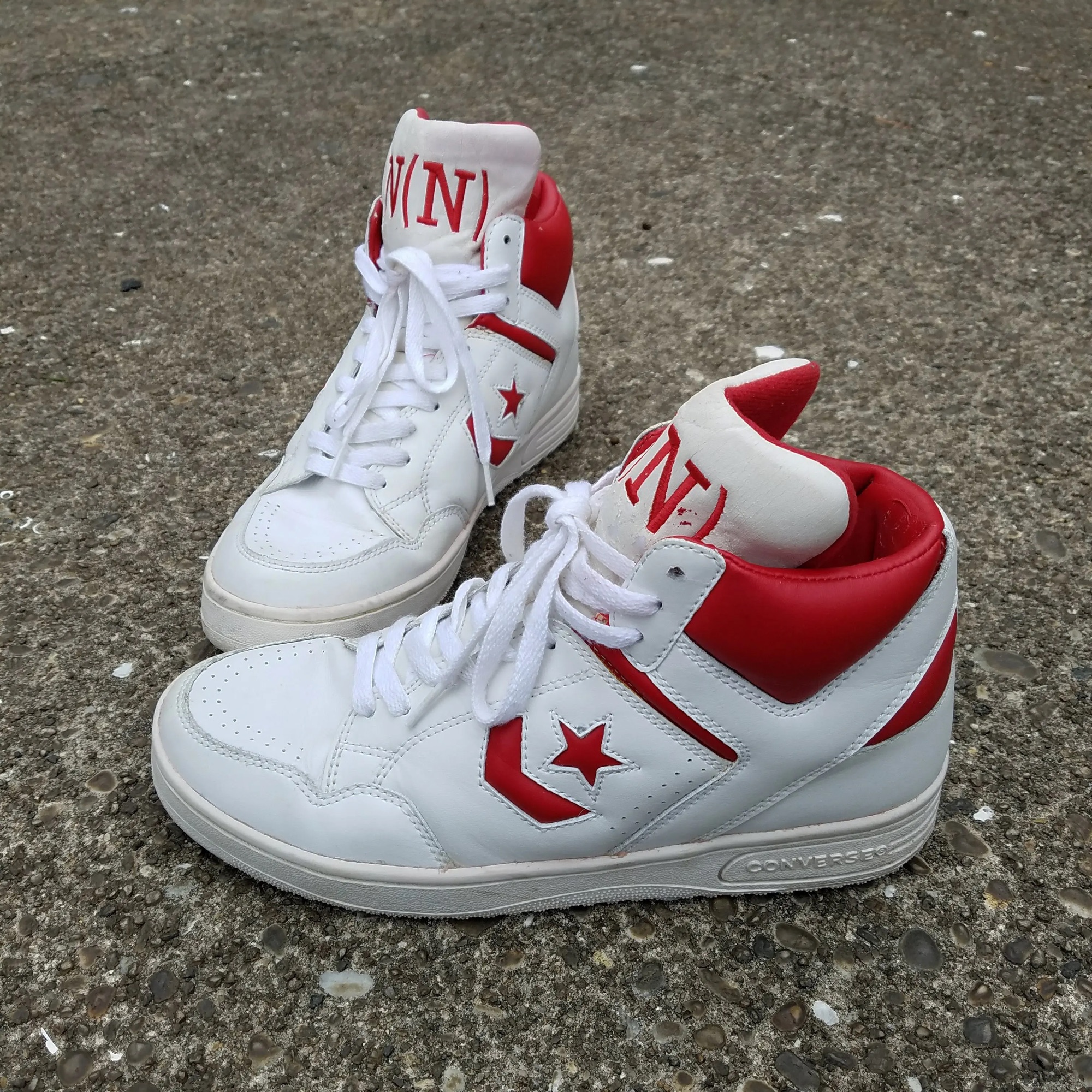
The first official interaction took place in (2006) when Number Nine reworked the Converse Weapon. This release is fully documented in announcements from the time. The model kept its original Eighties shape but featured a Number Nine branded tongue patch and premium leather construction. Two colorways were produced. One in black and white and another in white and red. It was the earliest sign that Miyashita intended to reinterpret Converse icons with detail driven craftsmanship rather than loud reinvention.

The next confirmed release arrived in (2008) when Number Nine produced a Jack Purcell with an engineered knitted upper. This version stands out because it replaced the standard Purcell canvas with a textured knit that softened the silhouette and gave it an unfamiliar luxury character. The shoe retailed for fifteen thousand seven hundred fifty yen in Number Nine stores, and the design was promoted as part of the label’s seasonal line rather than a mass market Converse drop.
Everything intensified in (2010). This is the year that Number Nine prepared to close, and the final Converse projects became part of the brand’s last chapter. The first pair released on March thirteen (2010). Two models appeared. A Chuck Taylor All Star Low in bright yellow shag suede, and a One Star Seventy Four Ox in white shag suede. Both used premium deer skin with a long textured nap. Both used the off center lace system that became the signature of the project. This lacing was inspired by the vintage Converse Odessa, which had an asymmetric lace placement in its original form. Retail price was one hundred forty dollars for each pair, and they launched through select global boutiques rather than general Converse distribution.


The reception was immediate. Media at the time highlighted the texture of the deer skin, the unusual lace placement, and the fact that this collaboration coincided with the end of the Number Nine label. Collectors quickly treated the models as archival items rather than seasonal footwear.
A second set arrived on May twenty two (2010). These pairs were built on the same silhouettes but executed in full black shag suede. The design features were identical. Same material. Same asymmetrical lace system. Same white midsole. These pairs served as a continuation of the March release and completed the asymmetrical Chuck and One Star group.


The final collaboration came in September (2010) and centered on the Converse Odessa. This release is one of the most documented in the partnership. Only ninety six pairs were produced. Forty eight in black and white, and forty eight in off white. All pairs were distributed through Aloha Rag in New York and Kicks Hawaii. The Odessa was built with the same deconstructed deer skin used in previous releases and carried the exact off center lace layout that defined the March and May drops. It is the rarest Number Nine Converse project ever released and marks the final moment before the closure of the label.
Every detail in this timeline is supported by release calendars, boutique announcements, and archived media coverage. There were no additional Number Nine Converse models outside these years. There were no reissues. There were no extended color programs or hidden samples released to the public. What exists is a small group of shoes that reflect the vision of a designer who spent his last season revisiting a piece of his own youth.


Today these pairs exist almost entirely within private collections. Some appear on resale platforms at prices far above original retail. The Odessa rarely appears in unworn condition. The March and May pairs are considered some of the most thoughtful reinterpretations of Converse classics created during that decade. They represent a moment where a Japanese label at its creative peak shaped American sneaker heritage through restraint, memory, and material choice.
Leave a Reply