
Dior Men’s Fall 2026


Jonathan Anderson said he did not want normality, and Dior took him at his word. The statement was made casually during a pre show press conference filmed by Luca Guadagnino, but it framed the entire collection. Nothing here aimed for ease. The characters were strange, deliberate, sometimes awkward, and carefully assembled. What held them together was not theme but tension. Between eras. Between luxury and utility. Between reverence and misuse.
The collection began with a moment that could have easily collapsed under its own symbolism. Anderson had acquired an unworn Paul Poiret dress from 1922, still wrapped in its original tissue paper. Poiret, who founded his house at twenty three and dominated Paris fashion during the Belle Époque, was not just a couturier but an architect of modern fashion itself. He dismantled the corset, liberated the body, and treated clothing as atmosphere rather than armor. By the early twenties, when this dress was made, Poiret was already drifting out of favor. His ideas had reshaped fashion, but the industry was moving on without him.
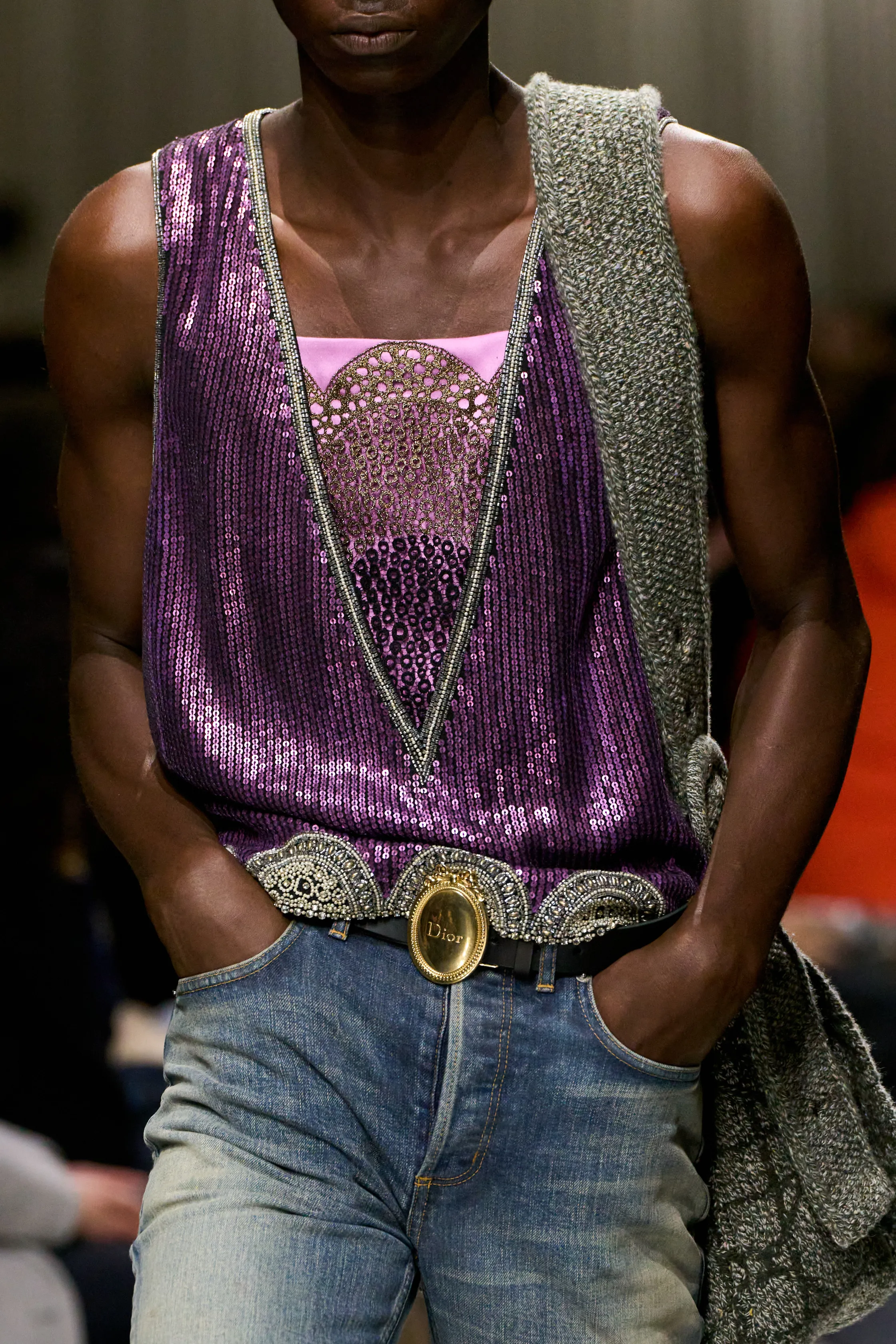
That moment of transition is what made the reference matter. Christian Dior would later rebuild structure, silhouette, and control with the New Look, but only because Poiret had first collapsed the old rules. Anderson understood this lineage. He did not present Poiret as a relic or a monument. He cut into the dress. The upper portion was reworked by the Dior ateliers and paired with denim, distressed jeans, Dior buckled belts, and Cuban heeled boots. It was not reverent. It was confrontational. History placed directly onto the present without explanation.
From there, the collection widened into something less literal but more revealing. Anderson explored moments where tailoring historically breaks down. Cropped double breasted jackets with pronounced shoulders nodded to the forties but ended abruptly at the waist. Hyper shrunken black jackets exposed the hipbone. Tailcoats were converted into cable knit sweaters. Ordinary wool sweaters were extended to ankle length, becoming something between uniform and interruption. The message was not destruction. It was instability.
The clothes themselves reinforced that unease. Heavy parkas with shearling collars sat beside ornate knitwear with epaulettes that felt ceremonial and oddly vulnerable. Military greens appeared in jacquard coats lined with lambswool and layered over ribbed knits. Plaid trousers were worn with embellished shoulders that suggested decoration without celebration. Leather trousers were paired with jewel toned knits that carried the weight of costume but refused theatrics. Even the wigs by Guido Palau played into this idea of character rather than styling. These were not looks meant to be liked. They were meant to be understood.
Poiret’s presence lingered throughout, not as a quote but as a method. He believed fashion should be seen from a distance, that it should project character rather than precision. Anderson translated that looseness into Dior’s technical discipline. Fabrics sourced from Poiret’s original suppliers appeared in modern garments. Cape like panels emerged from topcoats. Butterfly jacquards referenced the archive without nostalgia. The result was not fusion but friction.
What ultimately gave the collection weight was Anderson’s restraint. Dior menswear has often struggled with excess. Here, the weirdness was controlled. The commerce was clear. The clothes were persuasive without being polite. Anderson resisted the urge to overwrite Dior’s language, which is where so many designers fail when stepping into legacy houses. Reinvention is easy. Continuity is not.
What made the show resonate was its refusal to treat history as something precious or untouchable. Anderson understands that fashion houses lose their language not when they change, but when they overcorrect. By working with Poiret at a moment of fragility rather than triumph, and by allowing those ideas to sit uncomfortably beside denim, fur, and distortion, Dior felt intellectually awake rather than reverent. This was not about honoring the past or breaking from it. It was about knowing it well enough to use it, which is far rarer, and far more difficult.
Leave a Reply