
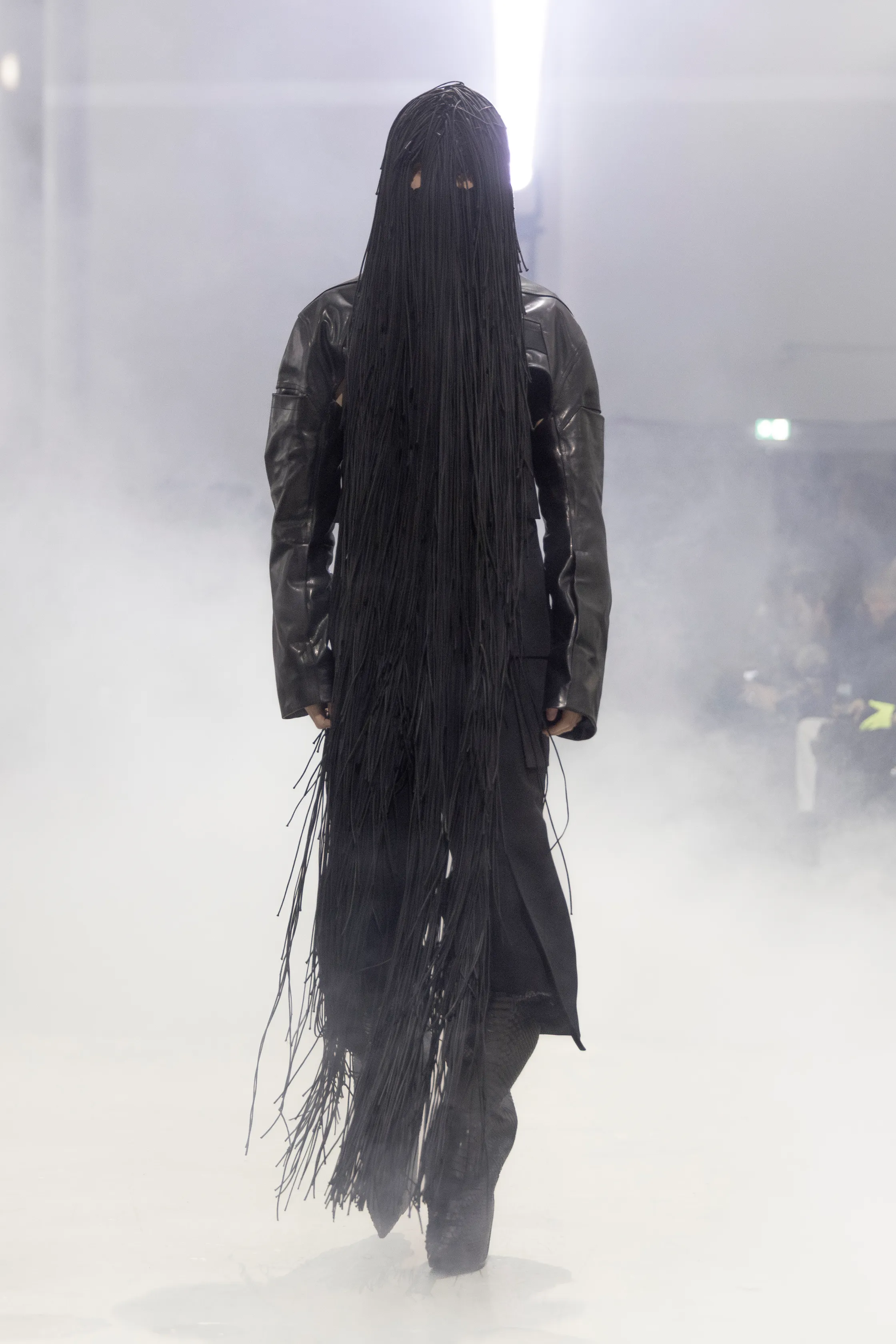
Rick Owen’s Fall 2026 Show


Rick Owens did not frame this collection as a protest, and that distinction mattered. He spoke instead about discomfort. About sensitivity. About the moment when a question feels charged enough that it cannot be avoided. The question this season was authority. Not authority as costume, but authority as pressure. As something worn daily. As something that shapes posture, silhouette, and behavior long before it becomes ideology.
The visual language flirted openly with uniform. Cropped flight jackets sat high and rigid on the body. Tactical shirting and armor like layers introduced a sense of sanctioned protection. Owens considered epaulettes and then rejected them, not because the idea lacked clarity, but because it was too explicit. Instead, he left behind the grommeted shoulder tabs where insignia should sit. Absence became the statement. Rank implied but never granted.
The runway emerged through dense fog and dry ice, models advancing like figures moving through tear gas rather than theatrical smoke. Faces were blank, stripped of expression. Sunglasses flattened emotion further. The effect was not intimidation, but distance. Power without spectacle. Control without clarity. Boots disrupted the line of the body entirely, extending and warping the foot into something closer to equipment than footwear. Occasional padded shoulder braces erupted into exaggerated paper boat extensions, absurd and functional at once.
The silhouettes were deliberately narrow. Skinny tailoring pushed the body into vulnerability, then armored over it with cropped cloaks, leather hybrids, and Kevlar like surfaces. Shirts cut from felt, wool, fur, and canvas carried a utilitarian severity, but never resolved into uniformity. Throat fastenings replaced epaulettes entirely, hovering between restraint and ornament. Were these figures enforcers or fugitives. The collection refused to decide.
That tension is less about heritage as symbolism and more about formation. Owens has spoken for years about growing up isolated, Catholic schooled, and visually overstimulated by fantasy while emotionally constrained by his surroundings. Porterville was not a place of ideology. It was a place of rules, restraint, and internal worlds. He learned early how systems press inward, not through spectacle, but through repetition. Dress codes. Moral codes. Behavioral expectations. Authority as atmosphere rather than event.
Before Paris, before fashion, before architecture and ritual entered the work, Owens was already negotiating control internally. His early fascination with glam, underground culture, and exaggerated bodies came not from rebellion for its own sake, but from a need to reframe discipline into something self authored. That instinct never left. What changed was its sophistication. Power, in his work, stopped being something to escape and became something to anatomize.
Owens does not aestheticize authority because he admires it. He studies it because he has lived under it in quiet, uncinematic ways. The uniforms, the tactical references, the insistence on structure all come from that long engagement with constraint. This is why his work rarely lands as protest and never as parody. It is too intimate for that. Authority in Rick Owens is never external. It is something worn, negotiated, and distorted until it becomes unstable.
Masks made this instability literal. Floor length constructions composed of endless lengths of waxed cord erased faces entirely, turning identity into silhouette alone. They suggested protection and punishment at the same time. Anonymity as armor. Anonymity as exposure. Owens has long understood that anonymity is one of power’s most potent tools, and here it became one of its most fragile.
What complicated the severity was the way the collection was made. Owens continues to design alone, without a traditional design room, maintaining absolute authorship over the core of his work. Yet this season he widened the perimeter deliberately. Collaborators were credited openly. Materials were traced back to their makers. Marbled, stiffened wool jackets were handmade by an atelier in Rajasthan using Himalayan fibers. Cropped gothic cashmere coats came from Straytukay. Hand knit cut out sweaters from Sarutanya. The masks from Lucas Moretti. Authority in appearance, collaboration in practice.
Owens has described this as a new system. It matters. The clothes may look authoritarian, but the process behind them is not. Control is aesthetic, not operational. Power is examined, not exercised.
This was not a collection about policing. It was about power made visible, exaggerated, and destabilized. Owens did not mock authority to neutralize it. He rendered it strange enough to weaken its hold. There was no call to action and no conclusion offered. Just the sense that power, once exaggerated and distorted, becomes something fragile, and that noticing this may be the only honest response fashion can offer.
Leave a Reply