
The Night Nirvana Redefined Unplugged and Kurt Cobain Became a Legend

On November 18, 1993, Nirvana stepped onto the small, dimly lit stage of Sony Music Studios in New York City to record what would become one of the most iconic live performances in music history. This was MTV Unplugged—but it wasn’t like any Unplugged set that had come before it. The space felt less like a concert venue and more like a wake. Draped in flowers and surrounded by soft candlelight, the stage had an air of quiet finality. Kurt Cobain later admitted that he had styled it to resemble a funeral, an idea that would take on a tragic new meaning just months later.
The room was filled with a crowd of fans, music industry insiders, and celebrity guests like Sonic Youth’s Kim Gordon and Thurston Moore, as well as supermodel Kate Moss. But even they didn’t know quite what to expect. Nirvana had never done an entirely acoustic set before. Stripped of their signature distortion and feedback, would the songs still hit as hard? The tension was palpable. Rolling Stone’s David Browne, who was in the audience that night, described the energy in the room as “mysterious,” like something unspoken was hanging in the air.
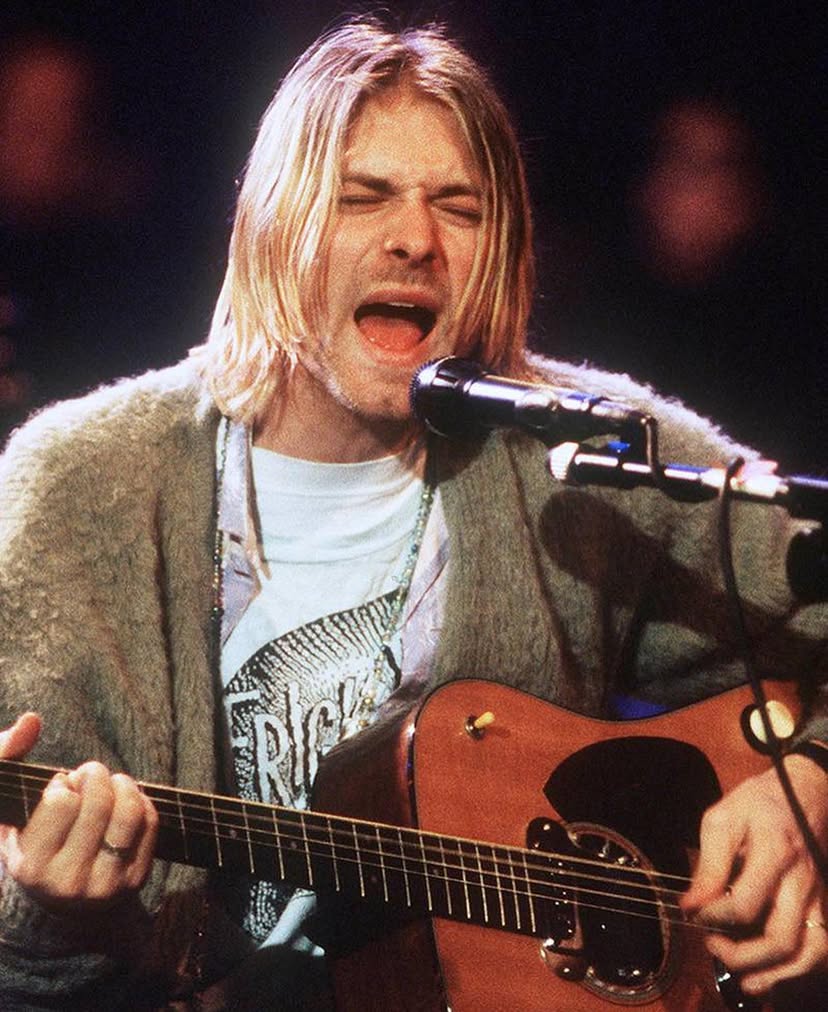
Cobain walked onto the stage looking like he had just rolled out of bed—but that only added to the mystique. His now-famous outfit—a loose green cardigan (destined for thrift-store legend), a Frightwig T-shirt, baggy Levi’s, and Jack Purcell sneakers—embodied the anti-style cool that would later be canonized as “grunge fashion.” His acoustic guitar wasn’t exactly pure either. It was secretly rigged with a pickup, allowing for a subtle boost in sound, but none of that really mattered. All eyes were on him
The band opened with “About a Girl,” a deep cut from their debut album Bleach. Stripped of its rough, lo-fi punch, the song was laid bare for what it truly was: a simple, perfect pop melody. If anyone in the crowd had doubts about how Nirvana’s music would translate to the acoustic format, they were gone within minutes. Each note hit with more clarity and precision than ever before. The harshness of Cobain’s electric growl was replaced with something more tender, but just as affecting.
As the set progressed, the band moved through tracks like “Come As You Are” and “All Apologies,” but it was clear this performance wasn’t about rolling out radio hits. Instead, Cobain dug into his vault of influences, performing covers that revealed his love for underground music. He brought out brothers Curt and Cris Kirkwood of the Meat Puppets to play three of their songs—“Plateau,” “Oh, Me,” and “Lake of Fire.” If anyone in the crowd was unfamiliar with the Meat Puppets before that night, they left as lifelong fans.
One of the most unforgettable moments of the night happened just before “Pennyroyal Tea.” Sitting alone onstage, Cobain glanced around, gave a small, wry smile, and muttered, “OK, but here’s another one I could screw up.” That line, so disarmingly human, captured the magic of the night. It wasn’t about perfection. It was about honesty. What followed was a sparse, achingly beautiful version of “Pennyroyal Tea,” Cobain’s voice cracking in all the right places, his guitar sounding as fragile as the man playing it.
Behind the scenes, not everything was as serene as it appeared onstage. Cobain was reportedly going through withdrawal the morning of the performance, but you’d never know it from his delivery. Every song was done in one take—no retakes, no do-overs. MTV producer Alex Coletti later confirmed this, emphasizing how rare it was for an Unplugged session to go off so seamlessly. Cobain’s ability to lock in and deliver such a vulnerable, career-defining performance in one go is a testament to his singular brilliance.
But the true climax of the night was the closer: “Where Did You Sleep Last Night,” a cover of a traditional folk song popularized by blues icon Lead Belly. Cobain’s version is raw, slow, and unrelenting. As he sings the final verse, his voice reaches an eerie, guttural howl that chills to the bone. His eyes close tightly, and for a moment, it looks as if he’s physically in pain. He doesn’t sing the final line of the song. Instead, he lets the silence hang. No one moves. No one claps. The stillness feels as sacred as any standing ovation.


When MTV released the footage as an album and video in late 1994, just months after Cobain’s death, it was impossible not to see the entire set as a kind of farewell. That image of Cobain—tired but radiant, powerful yet vulnerable—became one of the defining portraits of his legacy. The cardigan he wore that night would later sell at auction for over $300,000, and the Unplugged album would go on to win a Grammy. But no award or auction could ever match the emotional weight of that night in November 1993. It wasn’t just a performance—it was a reckoning with mortality, legacy, and the beauty that can exist in fragility.
Below is more footage from that night
Leave a Reply