
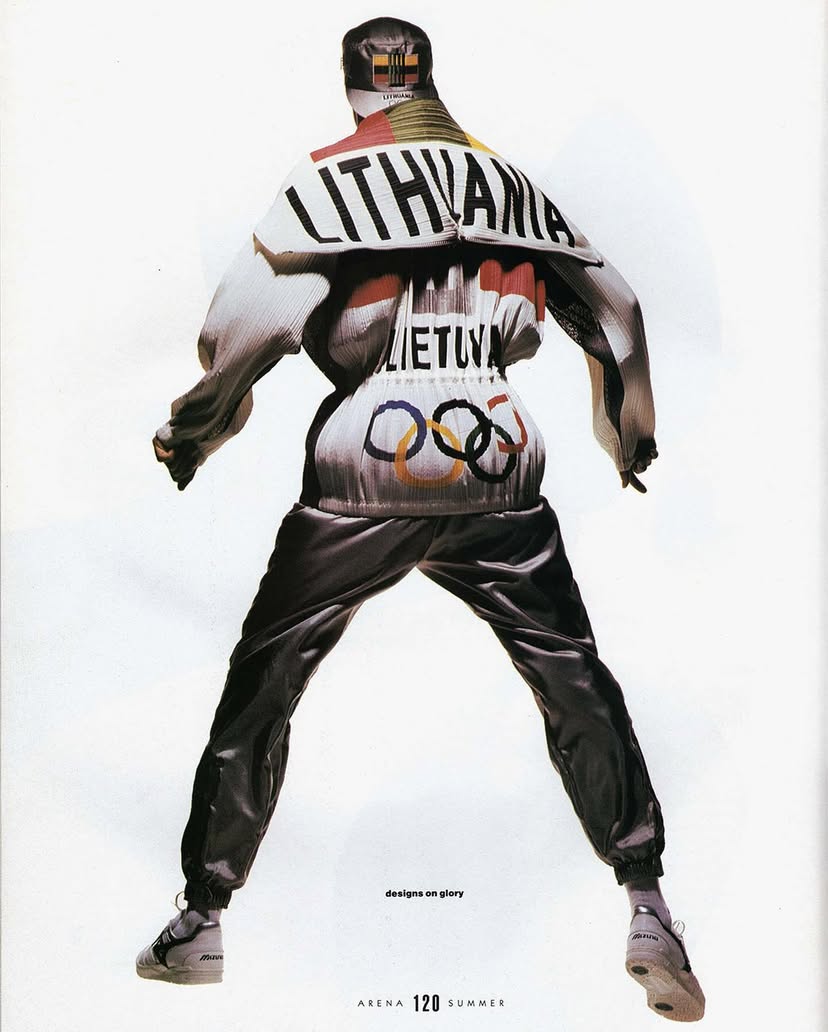
Issey Miyake and Lithuania: A Historic Olympic Partnership

In 1992, Lithuania found itself standing at a pivotal moment in its history. After decades of Soviet rule, the nation had regained its independence and was preparing to rejoin the Olympic Games for the first time in 64 years. The symbolic importance of this moment wasn’t lost on the Lithuanian Olympic team, who sought a way to make their presence felt on the global stage—through more than just athletic prowess. It was Dr. Edward Domanskis, the team’s physician and spokesman, who had an idea that would set a unique and historic collaboration in motion.
Dr. Domanskis, an admirer of Japanese designer Issey Miyake, decided to reach out directly to the visionary fashion pioneer with an audacious request: would Miyake be willing to design the Lithuanian team’s uniforms for the Summer Olympics in Barcelona? The idea may have seemed improbable. Lithuania and Miyake had no prior connection, and Lithuania itself was only beginning to step back into international prominence. But to Domanskis’s surprise, Miyake embraced the opportunity without hesitation.
For Miyake, the timing couldn’t have been better. His studio had recently developed a revolutionary pleating technology, a process that allowed fabric to stretch and conform to different body types while retaining its structural integrity. The challenge of creating a uniform that could fit athletes of all shapes and sizes perfectly suited this innovation. Miyake recognized not only the functionality that sportswear demanded but also its symbolic power as a canvas for creativity, unity, and national identity.
Collaborating closely with Naoki Takizawa, then chief of the design staff at Miyake Design Studio, and Makiko Minagawa, the studio’s textile director, Miyake set about creating something entirely new. Takizawa designed a series of uniforms that made groundbreaking use of pleats, a hallmark of Miyake’s aesthetic. Pleats provided a level of flexibility that traditional materials couldn’t achieve—an ideal solution for the diverse physiques of Olympic athletes. The uniforms also introduced experimental techniques such as heat cutting and heat treating, which allowed for intricate customization, including the application of patches—a first for pleated garments.
The final design was unveiled at the Foreign Correspondents’ Club of Japan before the Olympics began, drawing widespread attention for its modernity and originality. The pleated garments combined the functional demands of sportswear with a distinctive aesthetic that felt both futuristic and deeply human. Bold colors and clean lines offered a fresh perspective on national uniforms, making a strong visual statement about Lithuania’s re-emergence on the world stage.


During the opening ceremony of the Barcelona Olympics, the Lithuanian team marched proudly in Miyake’s designs. It was a moment of profound significance—a small country asserting its place among global powers with both grace and innovation. The uniforms not only served their functional purpose but also symbolized a fusion of cultures, creativity, and resilience.
The impact of this collaboration extended far beyond the Games. Inspired by the project, Miyake adapted the designs for his Spring/Summer 1993 ISSEY MIYAKE MEN collection, reinterpreting the concept for over 20 different countries. These pieces maintained the essence of the Lithuanian uniforms while expanding the idea to a broader audience, showcasing Miyake’s vision for a global, interconnected world of fashion. The uniforms even crossed into popular culture—Sapeur icon Papa Wemba wore the United Kingdom-inspired version on the cover of his 1995 album Emotion and in the music video for Yolele, further cementing their place in history.
Reflecting on the project, Miyake saw sportswear as a medium for innovation and change. For him, the partnership with Lithuania represented not just a moment of creative exploration but also an opportunity to envision what clothing could be in the 21st century: functional, inclusive, and imbued with cultural significance. He spoke of the “fresh sensations” that sportswear offered, its ability to transcend boundaries of tradition and embrace the dynamic, ever-changing nature of life itself.


The collaboration between Issey Miyake and the Lithuanian Olympic team stands as a testament to the power of bold ideas and human connection. It began with a simple letter and blossomed into a partnership that merged fashion, sports, and history in a way that continues to resonate. For Lithuania, it was a proud declaration of independence and identity. For Miyake, it was an affirmation of his belief in the transformative potential of design. Together, they created a story that remains both extraordinary and timeless.
Leave a Reply