
Sidewalks to Showrooms: How Skateboarding Shaped Virgil Abloh’s Vision

In the world Virgil Abloh built, skateboarding wasn’t a subculture—it was an architecture. A framework. Not something that influenced him in passing, but something foundational to how he thought about form, space, style, and disruption. Before he had the keys to Louis Vuitton, before the world knew what Off-White meant, Virgil was just a kid in Rockford, Illinois, downloading inspiration off the internet and watching skate tapes like they were sacred.
The thing about skateboarding is that it teaches you how to fall. And how to get back up. It rewards persistence and creativity in equal measure. Every stair set is a canvas. Every trick, an act of authorship. For Virgil, it wasn’t just the movement that fascinated him—it was the codes, the mythology, the self-mythologizing, the design language that existed around the board.
He didn’t skate professionally. But that wasn’t the point. He studied it the same way he studied architecture and DJing and Renaissance sculpture: as a language that could be recontextualized. You can trace the energy of skateboarding through everything he did. The raw, chipped texture of Off-White’s zip ties. The defiant practicality of his “SHOELACES.” Even the way he communicated—everything in quotation marks, like a permanent wink.


Then, in 2020, he made the most literal connection. Lucien Clarke—Jamaican-born, London-bred—became the first skateboarder signed to Louis Vuitton. More importantly, he was the first Black skater to receive a signature pro model shoe under the house. That detail mattered. Virgil didn’t just want to put skate culture on a runway. He wanted to put the people who lived it at the center of the frame.
The shoe they built together, the LV “A View,” was sleek, technical, and unapologetically luxe. It wasn’t trying to be a traditional skate shoe. It was trying to be a Virgil Abloh skate shoe—design-forward but rooted in function, a contradiction by design. Lucien skated it in the real world: the streets of London, Paris, wherever the session took them. There was no separation between performance and presentation. The thing was meant to get scuffed.
To understand why Virgil did this, you have to understand his version of luxury. It wasn’t about exclusivity. It was about access. Skateboarding, for all its perceived edginess, is one of the most democratic sports on earth. A $50 board and a sidewalk is all you need. Virgil knew that. He also knew the world rarely gave kids who looked like him or Lucien the tools—or the platforms—to express themselves at the highest levels of art and fashion. So he built them.


In Ghana, he helped fund and support the Freedom Skatepark, a safe space for young skaters and creatives to find their footing—literally and metaphorically. Back in the States, he launched events like the Abloh Invitational, not just to celebrate skateboarding but to create a kind of cultural gathering point. Skating, music, design, conversation. All in one place.
There’s a quote Virgil gave in a GQ interview that loops in the background now. “I feel like I’m ringing the bell for progression of the sport, in an authentic way.” And he was. Not through branded content or nostalgia or co-opting aesthetics. But by giving skateboarding a new reference point—luxury as a medium for truth-telling, identity-making, and creative autonomy.
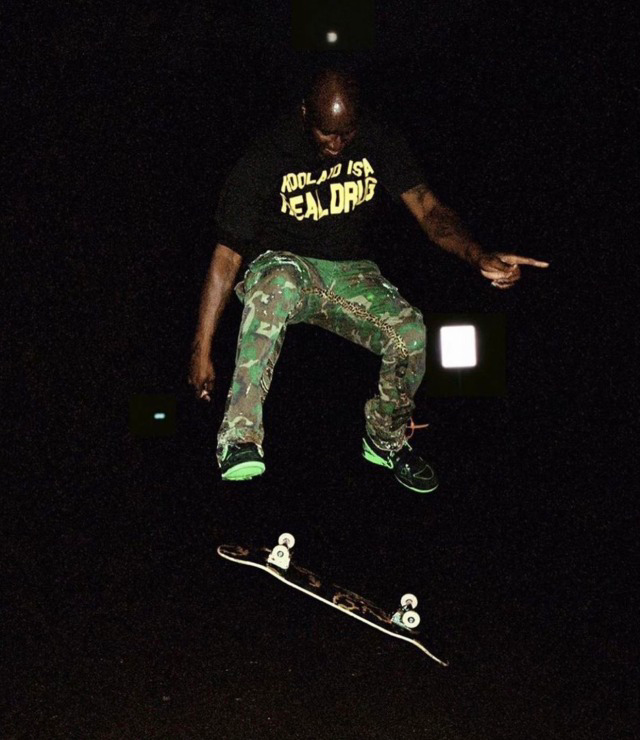
To call skateboarding an “influence” would be missing the point. It was a blueprint. A mentality. A way of seeing the world sideways—and making space for others to do the same. Below are some videos of Virgil enjoying skateboarding.
Leave a Reply