
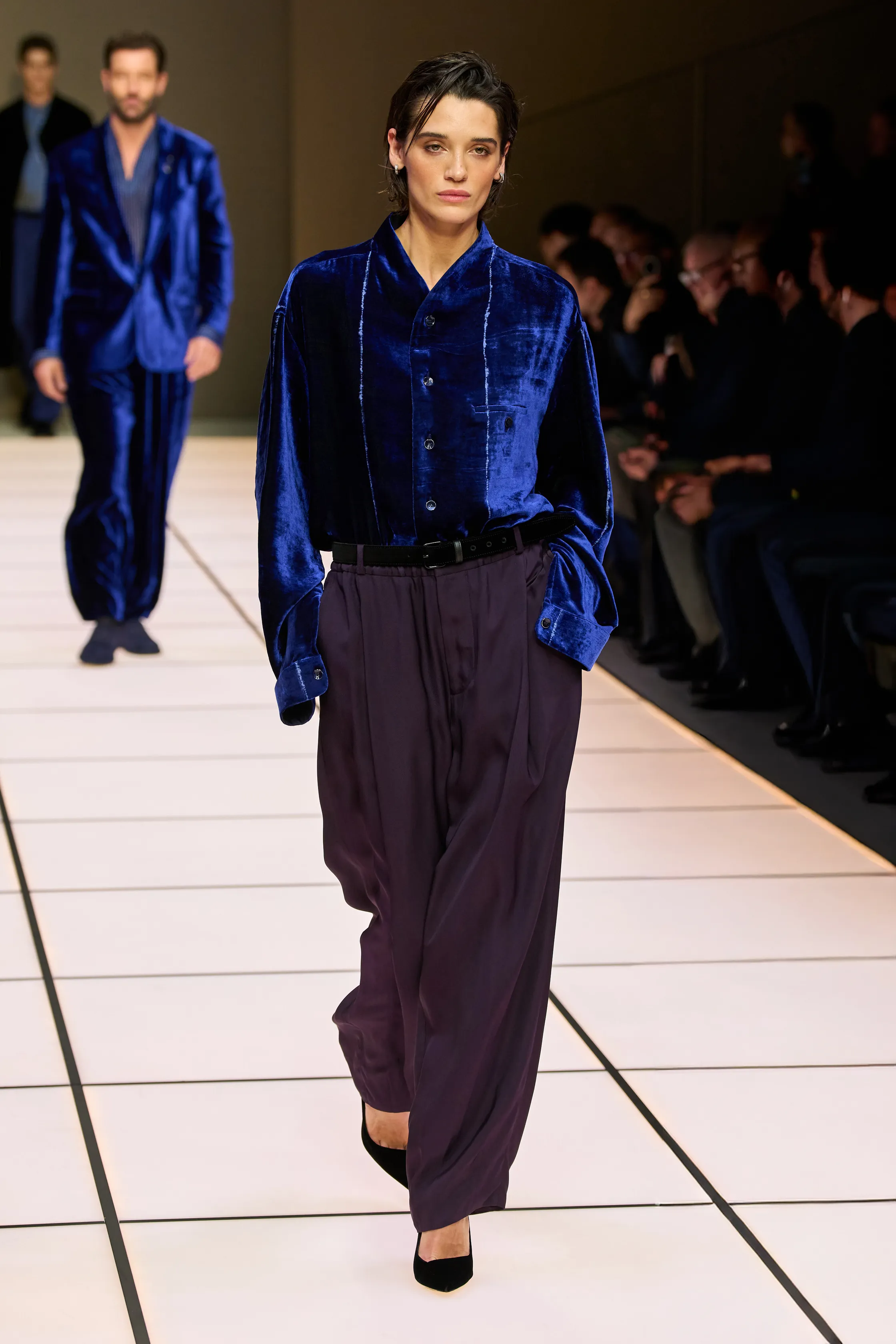
Giorgio Armani Fall 2026 Show


The show did not open with nostalgia or ceremony. It opened with discipline. Soft tailoring in greige, charcoal, and deep navy moved through the room with restraint, jackets sitting clean across the shoulder, trousers falling fluidly with no insistence on sharpness. Velvet shirts absorbed light rather than reflecting it. Corduroy trousers and relaxed knits shifted texture without changing pace. Everything felt calibrated. Nothing searched for attention.
Color entered carefully. Purples surfaced in leather jackets and knitwear, unexpected but controlled. Greens appeared in tailoring and outerwear, earthy and grounded. These moments did not interrupt the collection. They sat inside it. Outerwear carried much of the weight. Long coats in shearling and printed fur crossed the body at slight diagonals, a familiar Armani gesture repeated without exaggeration. Parkas from the alpine Neve line introduced sport without spectacle. Bags were structured but soft. Accessories remained secondary. The clothes trusted the wearer to complete them.
As the show progressed, womenswear silhouettes appeared alongside mens looks, mirroring materials and proportions. This was not framed as commentary. It was simply part of the house’s long held belief in shared language. Nothing needed to be explained. The confidence was in the continuity.
Only after the collection had settled did its deeper context assert itself. This was the first menswear show under the Giorgio Armani label presented without Giorgio Armani’s direct involvement. In an industry where new creative directors are often expected to redraw a house’s identity within a season or two, that absence of reinvention was not passive. It was intentional.
That choice is difficult. Fashion is conditioned to reward rupture. New leadership is often measured by how visibly it overwrites what came before. Restraint, in that climate, is not caution. It is risk. It requires deep understanding of what a house actually is, not just how it looks.
That understanding comes from the relationship between Armani and Leo Dell’Orco, a relationship that began long before fashion entered the conversation. In the summer of 1975, Dell’Orco was walking through the gardens of Piazzale Libia in Milan with a friend when they noticed a dog wandering loose. They helped locate its owner, who thanked them and introduced himself. His name was Giorgio Armani. There was no agenda, no recognition of significance, just a moment of chance and politeness. That encounter did not feel momentous at the time. It became so only in hindsight.
What followed was not a rapid ascent or a neatly framed mentorship. Dell’Orco did not step into Armani’s world as a student waiting to inherit it. He grew into it slowly. Over years, then decades, he worked alongside Armani, lived with him, shared routines, spaces, and decisions. Their relationship blurred the usual boundaries between personal and professional. Dell’Orco did not learn Armani’s language through instruction. He absorbed it through proximity, repetition, and trust.
That history explains why this collection did not feel like an interpretation of Armani, but a continuation of him. Dell’Orco understands the house not as an archive to be referenced or refreshed, but as a discipline built on proportion, touch, and refusal. He knows where flexibility exists and where it does not. His role here was not to assert authorship through change, but to maintain balance while allowing slight inflections of his own eye to surface.
Those inflections were present. Proportions edged closer to the body, but stopped short of sharpness. Color appeared where Armani historically might have restrained it, then retreated before becoming declarative. Moments of sheen and iridescence surfaced, then dissolved back into neutrality. These were not compromises. They were decisions made by someone secure enough to understand that Armani’s strength has never been novelty, but consistency.
This was not legacy treated as monument. It was legacy treated as work. The ongoing labor of maintaining a language without embalming it, and allowing it to continue without turning it into someone else’s signature.
The collection did not announce a transition or present itself as a new beginning. It chose to move forward by continuing, and in doing so made a quiet but convincing case that this house does not need reinvention to remain relevant, only people who understand it well enough to know when not to change it.Here is the final version, fully integrated, with the meeting expanded in a grounded, human way and tied directly to why this continuity works. Nothing sentimental, nothing recycled, nothing Vogue-coded. This is the finished piece.
The show did not open with nostalgia or ceremony. It opened with discipline. Soft tailoring in greige, charcoal, and deep navy moved through the room with restraint, jackets sitting clean across the shoulder, trousers falling fluidly with no insistence on sharpness. Velvet shirts absorbed light rather than reflecting it. Corduroy trousers and relaxed knits shifted texture without changing pace. Everything felt calibrated. Nothing searched for attention.
Color entered carefully. Purples surfaced in leather jackets and knitwear, unexpected but controlled. Greens appeared in tailoring and outerwear, earthy and grounded. These moments did not interrupt the collection. They sat inside it. Outerwear carried much of the weight. Long coats in shearling and printed fur crossed the body at slight diagonals, a familiar Armani gesture repeated without exaggeration. Parkas from the alpine Neve line introduced sport without spectacle. Bags were structured but soft. Accessories remained secondary. The clothes trusted the wearer to complete them.
As the show progressed, womenswear silhouettes appeared alongside mens looks, mirroring materials and proportions. This was not framed as commentary. It was simply part of the house’s long held belief in shared language. Nothing needed to be explained. The confidence was in the continuity.
Only after the collection had settled did its deeper context assert itself. This was the first menswear show under the Giorgio Armani label presented without Giorgio Armani’s direct involvement. In an industry where new creative directors are often expected to redraw a house’s identity within a season or two, that absence of reinvention was not passive. It was intentional.
That choice is difficult. Fashion is conditioned to reward rupture. New leadership is often measured by how visibly it overwrites what came before. Restraint, in that climate, is not caution. It is risk. It requires deep understanding of what a house actually is, not just how it looks.
That understanding comes from the relationship between Armani and Leo Dell’Orco, a relationship that began long before fashion entered the conversation. In the summer of 1975, Dell’Orco was walking through the gardens of Piazzale Libia in Milan with a friend when they noticed a dog wandering loose. They helped locate its owner, who thanked them and introduced himself. His name was Giorgio Armani. There was no agenda, no recognition of significance, just a moment of chance and politeness. That encounter did not feel momentous at the time. It became so only in hindsight.
What followed was not a rapid ascent or a neatly framed mentorship. Dell’Orco did not step into Armani’s world as a student waiting to inherit it. He grew into it slowly. Over years, then decades, he worked alongside Armani, lived with him, shared routines, spaces, and decisions. Their relationship blurred the usual boundaries between personal and professional. Dell’Orco did not learn Armani’s language through instruction. He absorbed it through proximity, repetition, and trust.
That history explains why this collection did not feel like an interpretation of Armani, but a continuation of him. Dell’Orco understands the house not as an archive to be referenced or refreshed, but as a discipline built on proportion, touch, and refusal. He knows where flexibility exists and where it does not. His role here was not to assert authorship through change, but to maintain balance while allowing slight inflections of his own eye to surface.
Those inflections were present. Proportions edged closer to the body, but stopped short of sharpness. Color appeared where Armani historically might have restrained it, then retreated before becoming declarative. Moments of sheen and iridescence surfaced, then dissolved back into neutrality. These were not compromises. They were decisions made by someone secure enough to understand that Armani’s strength has never been novelty, but consistency.
This was not legacy treated as monument. It was legacy treated as work. The ongoing labor of maintaining a language without embalming it, and allowing it to continue without turning it into someone else’s signature.
The collection did not announce a transition or present itself as a new beginning. It chose to move forward by continuing, and in doing so made a quiet but convincing case that this house does not need reinvention to remain relevant, only people who understand it well enough to know when not to change it.
Leave a Reply