
A history shaped by war and the rise of the global fashion calendar

Before fashion weeks existed as an organized global system, fashion functioned through hierarchy, proximity, and privilege. In the nineteenth century, modern fashion as an industry began in Paris with Charles Frederick Worth, who is widely recognized as the founder of haute couture. Worth was the first designer to place his name inside garments, present seasonal collections on live models, and dictate trends rather than simply respond to client demand. His salon established the idea that fashion could originate from a single creative authority. From that moment forward, Paris became the uncontested center of fashion power.
For decades, couture houses in Paris presented collections privately to elite clients. Buyers and editors moved quietly between salons. There was no shared calendar, no standardized schedule, and no expectation that designers coordinate with one another. Fashion existed in fragments, governed by personal relationships and geographic access. Other countries produced clothing, but Paris defined legitimacy. This structure persisted well into the early twentieth century.
By the 1920s and 1930s, the United States had developed one of the largest garment manufacturing industries in the world, centered in New York City. American designers worked closely with factories and department stores, producing ready to wear clothing adapted from Parisian styles. Department stores such as Saks Fifth Avenue and Bergdorf Goodman hosted fashion shows as promotional tools, often on the same nights, competing for press attention. These shows were commercial events, not cultural ones. Editors still viewed Paris as the source of innovation and America as the interpreter.
This hierarchy collapsed during the Second World War. When Germany occupied France in 1940, international travel ceased and Paris couture houses were restricted by occupation rules, material shortages, and censorship. American editors could no longer attend Paris shows. Couture fittings were suspended. Fashion photography slowed dramatically. The global fashion system lost its central authority overnight. This was not only an aesthetic disruption but an economic one. Magazines still needed content. Retailers still needed collections. Consumers still wanted clothing. The existing system could not function.
At the same time, American society was changing rapidly. Millions of men were sent overseas and women entered the workforce in unprecedented numbers. Clothing had to reflect physical labor, mobility, and practicality. Fabric rationing limited excess ornamentation and encouraged efficient construction. American designers were well equipped for this reality. What they lacked was visibility.
In 1943, that visibility was created by Eleanor Lambert, a publicist working with the New York Dress Institute. Lambert recognized that American designers were not absent from culture because of inferior design, but because there was no structure presenting them collectively. Editors encountered American fashion sporadically while following buyers between showrooms. There was no narrative continuity. Lambert believed fashion required organization, repetition, and timing to gain authority.

She created Press Week in July 1943 at the Plaza Hotel in New York City. It was designed exclusively for journalists. Buyers and the public were excluded. Over fifty American designers presented collections according to a strict schedule. Editors were flown in from across the country. Live models walked elevated platforms under theatrical lighting. Press materials were prepared in advance to ensure immediate publication. For the first time, fashion was presented as an industry operating on a calendar.
Press Week succeeded, but it exposed a new problem. As the number of shows grew, scheduling conflicts became inevitable. That problem was solved by Lambert’s assistant, Ruth Finley.

Finley conceived the idea for what became the Fashion Calendar after overhearing two frustrated fashion writers debating whether to attend a Saks Fifth Avenue or Bergdorf Goodman event scheduled on the same night. She realized that fashion needed coordination as much as promotion. In 1945, she began publishing small pink booklets under the name Fashion Calendar. These booklets listed every show, presentation, and event in New York, organized so that designers did not compete for attention at the same time.
The Fashion Calendar became the blueprint for how fashion weeks operate globally. Designers were given approximately fifteen minutes to present their collections. Editors, buyers, manufacturers, and cultural figures moved from show to show in rapid succession. The format rewarded clarity, impact, and memorability. Designers had to stand out quickly. This compressed presentation model reshaped design, casting, staging, and storytelling. Fashion became performative out of necessity.
For decades, Finley personally maintained the calendar, effectively controlling access to fashion week. Inclusion signaled legitimacy. Exclusion meant invisibility. In 2014, the Council of Fashion Designers of America officially acquired the Fashion Calendar, assuming control of the New York Fashion Week schedule and formalizing its institutional authority. Finley’s story was later documented in the 2022 film Calendar Girl, which chronicles how one individual quietly shaped the modern fashion system.
While New York formalized ready to wear presentation, Paris reasserted itself in a different way. The defining moment came on November 28, 1973, with an event known as the Battle of Versailles. Held at the Palace of Versailles as a fundraiser for the restoration of the royal residence, the event was organized by the French Fashion Federation and overseen by Eleanor Lambert.
The Battle of Versailles was the first time haute couture, ready to wear, and menswear were presented together in Paris. It brought five French designers and five American designers onto the same stage. Representing France were Yves Saint Laurent, Emanuel Ungaro, Pierre Cardin, Hubert de Givenchy, and Marc Boban for Christian Dior. Representing the United States were Anne Klein, accompanied by her assistant Donna Karan, along with Halston, Oscar de la Renta, Bill Blass, and Stephen Burrows.

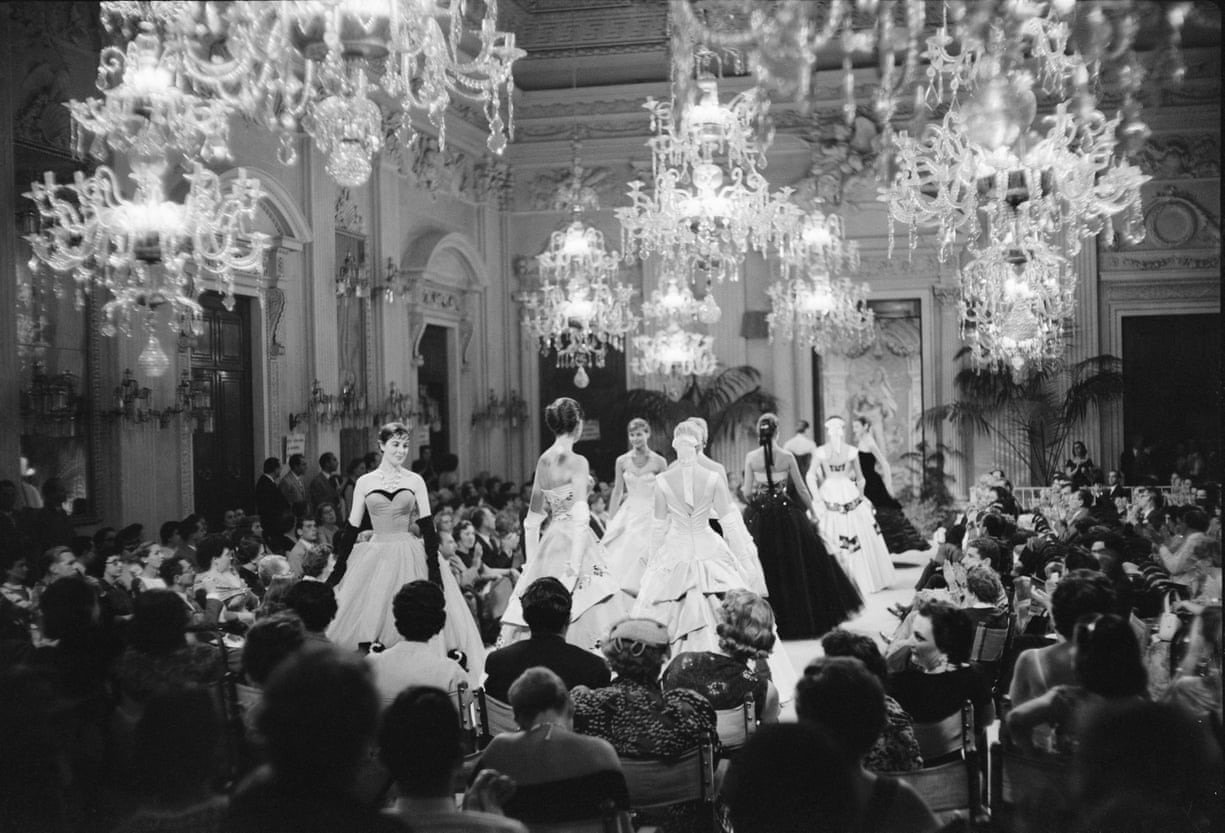
A model wears Christian Dior’s ‘New Look’, 1947. Keystone-France
Although framed as a friendly competition, the impact was decisive. The American designers emphasized movement, energy, and diversity, featuring Black models and a more dynamic presentation style. The response was overwhelming. The Americans were widely seen as having won the night, permanently shifting perceptions of American fashion. The event solidified Paris Fashion Week as a formalized, international stage rather than a purely French one.
London followed a different path. The first London fashion week was held in 1984 in a car park in West London, with tents erected outside the Commonwealth Institute in Kensington. Early designers included Betty Jackson, David Fielden, and John Galliano. The setting reflected Britain’s positioning of fashion as experimental, subcultural, and resistant to traditional luxury norms.
The success of the event prompted the UK government to provide official funding, recognizing fashion as a cultural and economic asset. British royalty soon took interest. Princess Diana hosted receptions for designers at Lancaster House in 1985. In 1986, Margaret Thatcher attended shows throughout the week, signaling institutional legitimacy. London Fashion Week became known for risk, youth culture, and conceptual design rather than commercial dominance.
Milan formalized its fashion week in 1958 through the Camera Nazionale della Moda Italiana, positioning Italy as the capital of luxury manufacturing and craftsmanship. Houses such as Gucci, Prada, Versace, and Armani came to define Milan’s identity through precision, material excellence, and industrial scale.
By the late twentieth century, New York, London, Milan, and Paris formed what became known as the Big Four. Together they established the global fashion calendar that still governs the industry today. What began as a wartime solution evolved into a system that dictates visibility, legitimacy, and cultural relevance.
Fashion weeks did not begin as spectacle. They began as infrastructure. They were built to organize time, control narrative, and concentrate attention. The same structure that once solved chaos now defines the industry’s rhythm. And as fashion continues to question its future, it is still operating within a system designed nearly eighty years ago to solve a very different problem.
.
Leave a Reply