
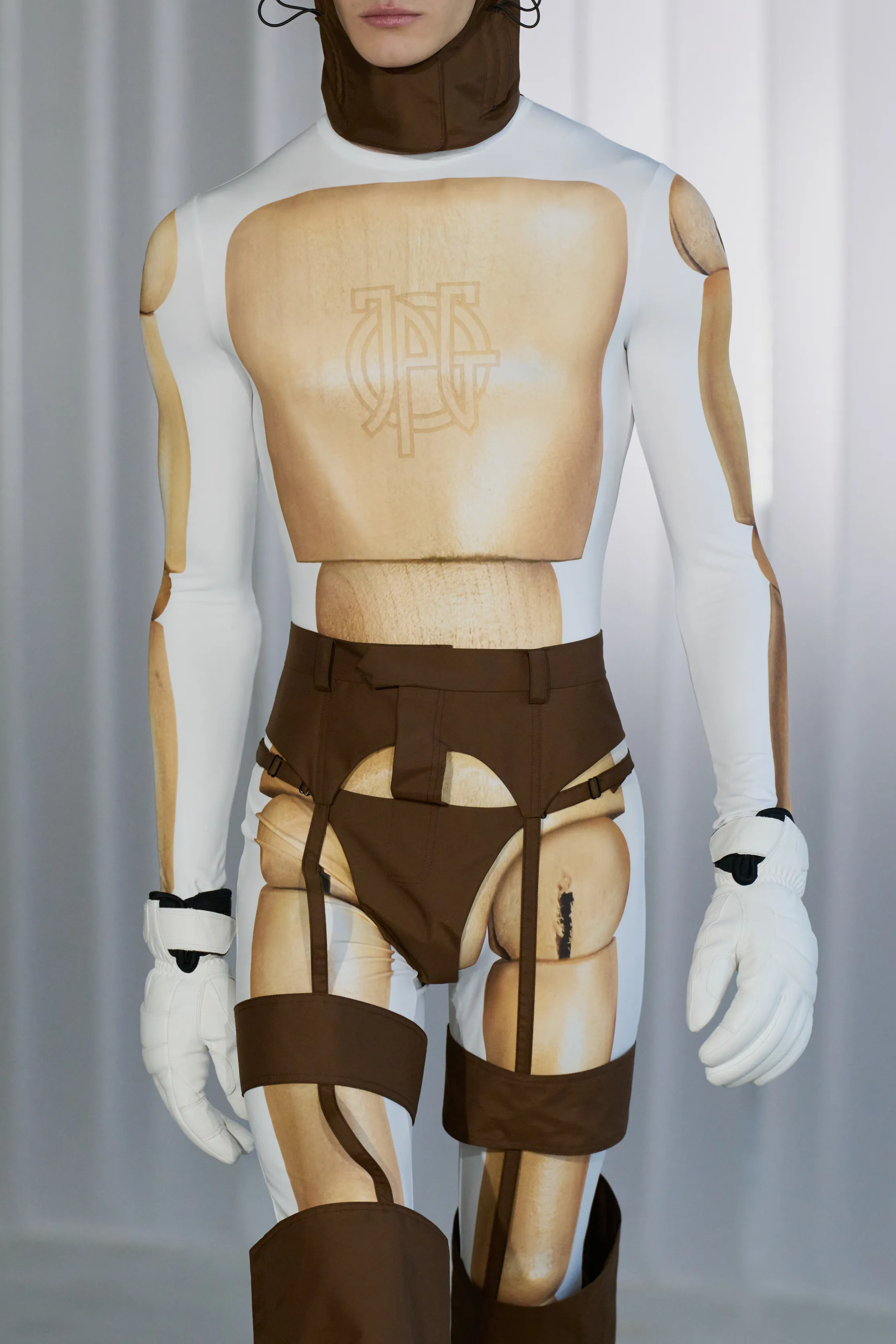
Jean Paul Gaultier Fall 2026 Ready To Wear: Madame Masculinity


For his first ready to wear outing at Jean Paul Gaultier, Duran Lantink stepped into a house that has always thrived on disruption. Since the beginning, Gaultier built his reputation by bending the rules of dress. Tailoring shifted out of proportion, lingerie stepped confidently into public view, and masculinity and femininity constantly exchanged roles. Lantink approached that history with the same spirit of curiosity, treating the suit not as a fixed uniform but as material that could be stretched, reshaped, and reconsidered.
The starting point came from a familiar image. Lantink referenced Marlene Dietrich holding a whip, a symbol of authority that blurred the usual lines between masculine tailoring and feminine allure. From that image the idea of what he called “Madame Masculinity” emerged, a framework for rethinking the language of the suit through displacement and reconstruction.
The early silhouettes immediately made clear where the collection was headed. At first glance the pieces looked rooted in traditional tailoring, but that familiarity rarely lasted long. Jackets twisted into new structures, collars expanded into sculptural forms, and classic menswear fabrics were pushed into shapes that felt closer to architecture than clothing.
One look centered on a sculptural bodice rising outward from the chest in a deep velvet curve, hovering above a nude corseted torso. Beneath it, sharply cut black trousers stabilized the silhouette, creating a clear tension between exaggeration and discipline. The result felt unmistakably connected to the house’s history of visual provocation.
At first it reads as pure exaggeration, yet the construction underneath reveals careful tailoring rather than simple gimmickry.
Elsewhere the collection leaned into Lantink’s interest in dramatic volume. A cropped black bomber jacket appeared paired with extremely narrow leggings and heavy boots, but the most striking element sat above the shoulders. A massive padded collar framed the head almost like a sculptural halo, transforming a familiar sportswear reference into something theatrical.
That balance between restraint and distortion continued in a pale body skimming dress that followed the figure with precise simplicity. From the neckline two structured black panels extended downward like an abstract interpretation of a necktie, turning a traditional emblem of male dress into an ornamental element within a fluid silhouette.
Humor surfaced again through subtle technical manipulations. A crisp white shirt front appeared reworked with vertical pleating down the torso, paired with tailored trousers and finished with a bright yellow hood that wrapped closely around the head. The look fused tailoring, workwear, and sportswear into a single composition that felt slightly surreal yet fully resolved.
Throughout the collection Lantink showed a willingness to stretch the vocabulary of the house while still respecting its foundations. Across the lineup, elements drawn from different wardrobes surfaced side by side, from corsetry to athletic silhouettes, often layered into the same composition.
Yet the collection remained grounded in the atelier’s deep tailoring expertise, particularly when traditional menswear fabrics were reconstructed into new shapes.
That tension has always defined Jean Paul Gaultier. Humor balanced with craftsmanship, provocation supported by technical precision. Lantink appears comfortable working inside that territory, approaching the archive with curiosity rather than reverence and pushing the language of the suit just far enough before it begins to collapse.
In a moment when much of fashion is forced to justify itself immediately, that kind of freedom to experiment feels unusual. At Jean Paul Gaultier, it remains the point.
Leave a Reply