Carl Randall’s paintings don’t arrive loudly. They settle in slowly, almost too quietly at first, and then start to rearrange how you’re reading the scene in front of you. What looks like straightforward figurative painting reveals itself as something more controlled, more constructed, and more psychological the longer you sit with it.
Born in London, Randall trained at the Slade School of Fine Art and the Royal Drawing School before relocating to Japan, where he spent close to a decade studying and working at Tokyo University of the Arts. That period becomes the foundation of his entire practice. Not just visually, but structurally. Tokyo is where he develops the habit of working directly from life, embedding himself in public spaces and observing people within systems rather than isolating them from it.
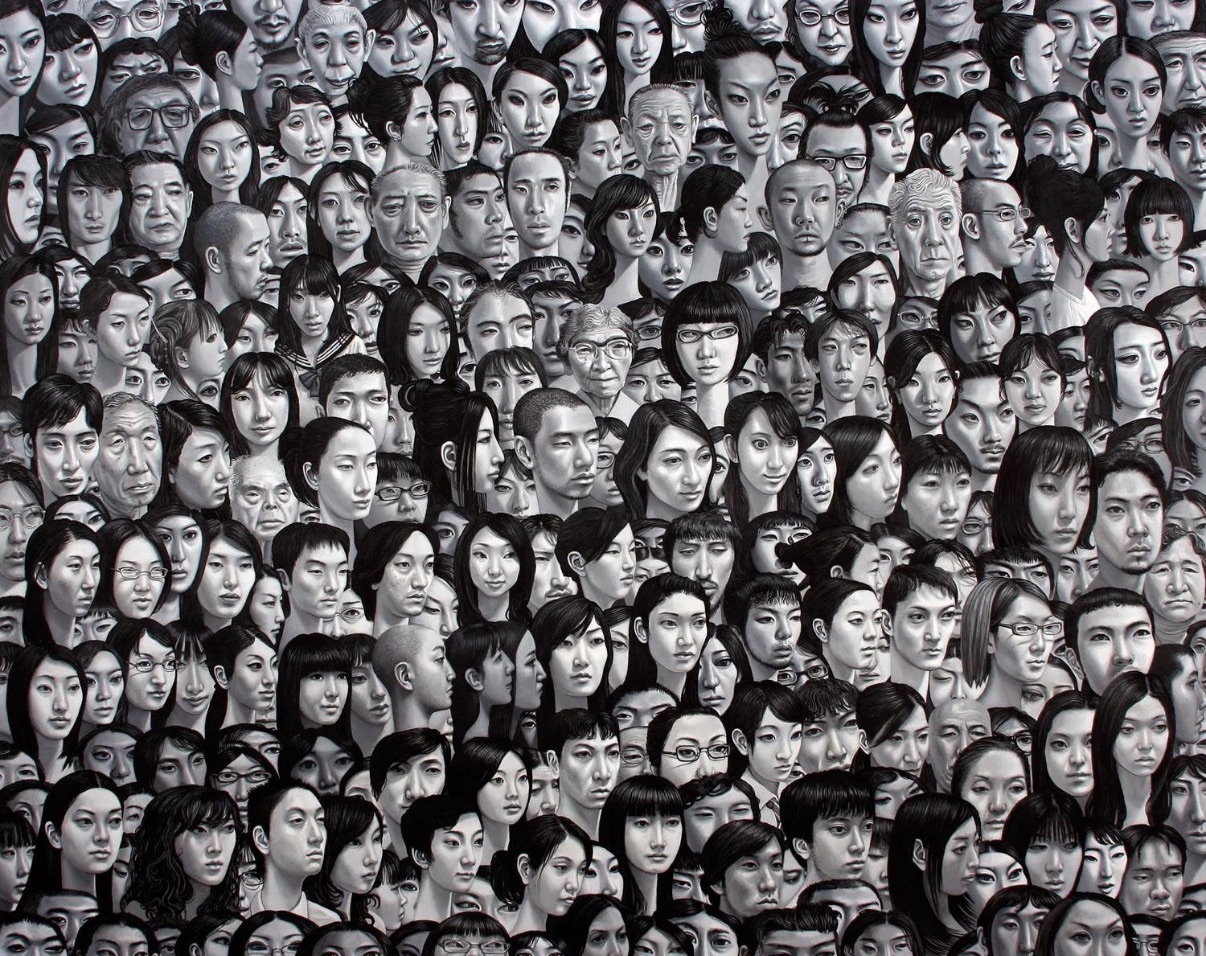
What comes out of that experience is a body of work that sits somewhere between portraiture and documentation. Randall paints commuters, workers, strangers, and crowds with a level of precision that feels almost archival, but the intention is not to record people as individuals. It is to understand how they exist within shared environments without ever fully connecting. His paintings hold that tension. Figures are physically close, often overlapping or compressed within the composition, yet psychologically distant.
That sense of distance is reinforced through his handling of space. Perspective is often flattened, backgrounds feel constructed rather than receding naturally, and repetition becomes a key device. Whether it is a sequence of faces in a crowd or the recurrence of a single element across the canvas, the image begins to take on a rhythm that feels deliberate and slightly unnatural. It is not surrealism, but it is not purely observational either. It sits in a controlled space between the two.
The painting of the two figures set against rice fields with dragonflies operates within that same logic. At first glance, it reads as a quieter, more rural departure from his urban work, but the underlying structure remains consistent. The landscape is not passive. The repetition of the dragonflies creates a visual pattern that mirrors the repetition of human presence in his city scenes. The figures themselves feel anchored and detached at the same time, rendered with clarity but positioned in a way that keeps them emotionally out of reach. The result is a scene that feels calm on the surface while carrying an undercurrent of unease.
Randall’s engagement with Japan extended beyond the city. After receiving the BP Travel Award, he retraced the historic Tōkaidō route, originally documented by Hiroshige, but approached it through a contemporary lens focused on people rather than pure landscape. This shift is important. It reinforces the idea that his work is not about place in isolation, but about how people move through it, inhabit it, and exist within its structures.
When he returns to London, that same framework carries over. The setting changes, but the method does not. Crowded intersections, nightlife, and public spaces become his subjects, treated with the same attention to proximity, repetition, and psychological separation. The work becomes less about geography and more about condition. Different cities, same underlying distance.
Technically, Randall works within a classical oil painting tradition, building surfaces through layering and careful observation. But the technical control is never the point on its own. It is what allows him to manipulate the image just enough to shift it out of pure realism. Faces elongate slightly, compositions tighten, and space compresses. These are small adjustments, but they accumulate into something that feels distinctly his.
His work now sits in major collections, often placed in proximity to artists whose practices operate very differently on the surface. That contrast is part of what makes his position interesting. Randall is not redefining painting through abstraction or spectacle. He is refining it through attention. Through a sustained focus on how people exist together without actually engaging with one another.
That is where the work holds. Not in any single figure or setting, but in the recognition of a shared experience that is rarely acknowledged directly. The paintings do not exaggerate it. They simply organize it in a way that makes it visible.