The reference point begins in the late 1960s with Allen Jones, whose sculptural works redefined how the body could exist within art. His figures were cast, lacquered, and positioned into fixed roles, often functioning as furniture. The body was no longer moving freely or being dressed. It was placed, controlled, and turned into object. That shift introduced a new way of thinking, where the human form could operate as structure rather than something to decorate.
Decades later, Alexander McQueen expanded that idea during his time at Givenchy. In 1997, working with London based effects studio Whittaker Malem, he moved fashion further away from fabric and toward form. Corsetry became molded and rigid, surfaces became seamless, and the body was recast through latex and sculptural construction. These pieces removed softness and natural movement, replacing it with precision and control. The garment disappeared into the body, leaving behind something closer to a constructed figure than a dressed one.
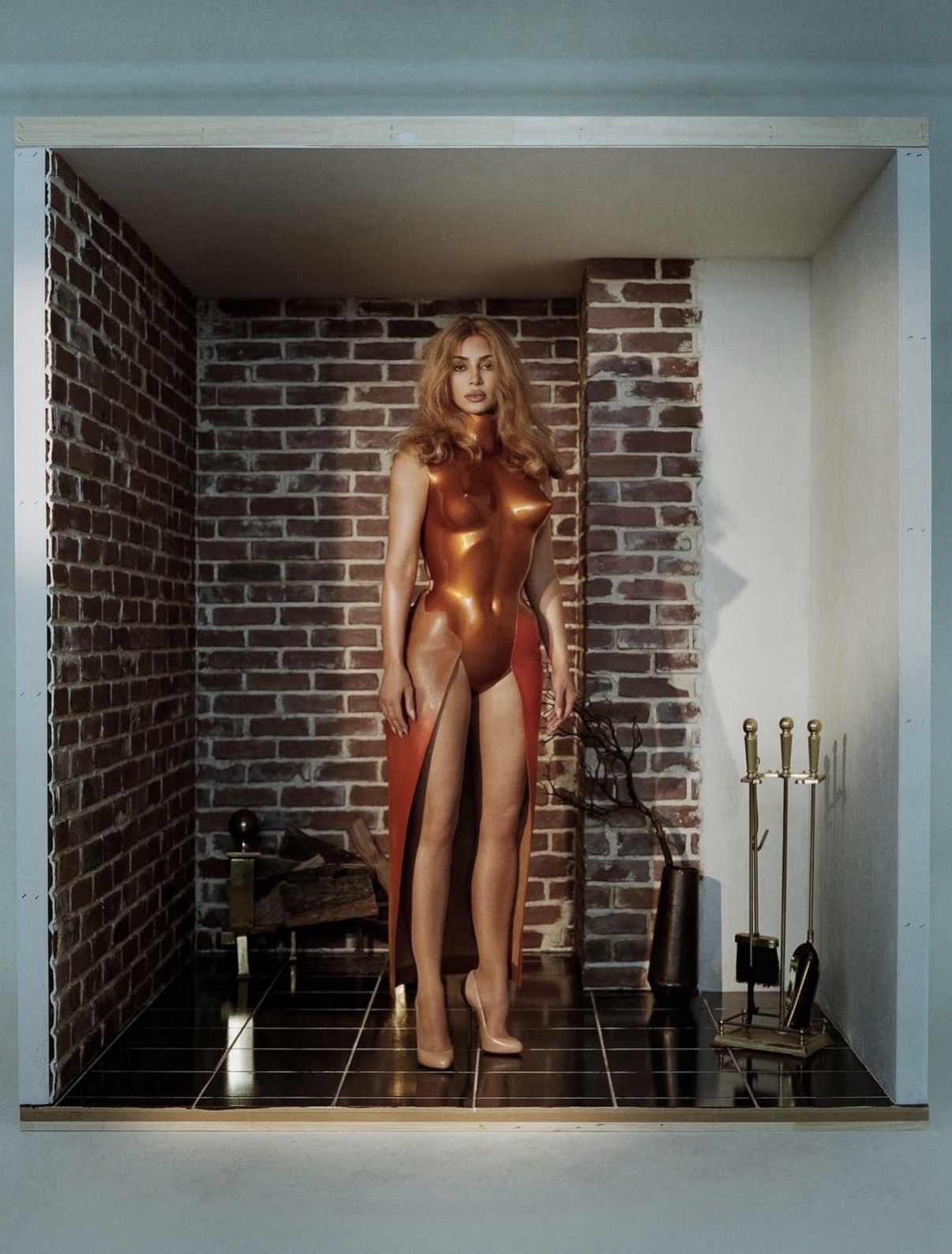
At the 2026 Met Gala, Kim Kardashian’s look sits directly within that lineage. She worked with Allen Jones on the concept, while Whittaker Malem handled the skirt, bringing both references into a single piece. The result is a fully sculpted metallic body that reads closer to a cast than a garment. The surface is continuous and reflective, eliminating any sense of traditional construction while subtly reshaping the proportions of the figure.
Within the context of “Costume Art,” the look does not rely on interpretation. It follows the same logic established by Jones and later pushed by McQueen, where the body is treated as structure rather than something to dress. It is fixed, defined, and presented, placing it closer to sculpture than fashion.