The Internet’s Runway


Before social media became one of fashion’s main discovery systems, VFILES was already treating the internet as a place where fashion careers could begin. Founded by Julie Anne Quay in 2012, VFILES was built as more than a publication or store. It combined a digital creative community, fashion retail, content and eventually an incubator for emerging talent. The company described its original mission around closing the opportunity gap and creating a more open creative system, while much of its programming relied on talent found through its own online community.
The most important extension of that idea became VFILES Runway. Designers submitted work online, while emerging models, stylists, photographers and beauty talent could also come through the wider community. Selected designers were then given something the internet alone could not provide: a physical stage during New York Fashion Week, industry mentorship and the attention of buyers, editors, artists and other people capable of moving a career forward. Earlier editions helped introduce names including Hyein Seo, Melitta Baumeister, Ximon Lee and Feng Chen Wang to larger audiences. Vogue noted in 2016 that the designers selected through VFILES were repeatedly landing directly inside conversations around gender fluidity, athleisure and other shifts happening among younger fashion consumers.
That was the real importance of VFILES. It did not invent internet fashion culture, but it understood how to turn it into infrastructure. Someone could exist outside the normal fashion pipeline, put their work online, get noticed through a community and eventually find themselves showing during Fashion Week. What now happens constantly through Instagram, TikTok, independent fashion pages and celebrity dressing was still becoming a recognizable system in the middle of the 2010s.
Spring 2017 became one of the clearest examples of that model working at full scale. Presented at Spring Studios on September 7, 2016, Runway 7 selected five very different designers: Rushemy Botter, Hong Kong label Ground Zero by brothers Eri and Philip Chu, Parsons graduate Song Seoyoon, Mexican designer Bárbara Sánchez Kane and Italian designer Alessandro Trincone. Their mentor panel was just as varied, bringing together Naomi Campbell, Pat McGrath, Jerry Lorenzo, Mel Ottenberg and Young Thug. The combination said almost everything about VFILES. A supermodel, makeup artist, stylist, streetwear designer and rapper could all be treated as legitimate sources of fashion knowledge.
The collections had no reason to resemble one another. Botter presented fluid oversized menswear alongside political slogans including messages against racism and terrorism. Ground Zero pulled apart familiar sportswear with ruching, oversized denim, florals and warped proportions. Song Seoyoon worked with clear and opaque plastic inspired by garment bags and the systems surrounding clothing production. Sánchez Kane pushed menswear into something more confrontational, mixing bondage, humor, sexuality, masks and exaggerated objects while questioning traditional gender roles. Trincone brought soft, highly constructed pleating, enormous volumes and Japanese influenced silhouettes that deliberately moved away from fixed ideas of masculine clothing.
Instead of forcing those designers under one visual identity, VFILES allowed the differences to become the identity. The platform was interested in what happened when young people from different countries, scenes and disciplines were placed inside the same room. The show itself reflected that thinking. Brooklyn metal band Unlocking the Truth performed, members of New York dance crew W.A.F.F.L.E. appeared, synchronized swimmers opened the night and Playboi Carti performed during the finale. Migos, Teyana Taylor, Cardi B, Luka Sabbat and others were among the crowd. Fashion was no longer being presented as something isolated from music or nightlife. It was being shown as one part of a much larger cultural network.
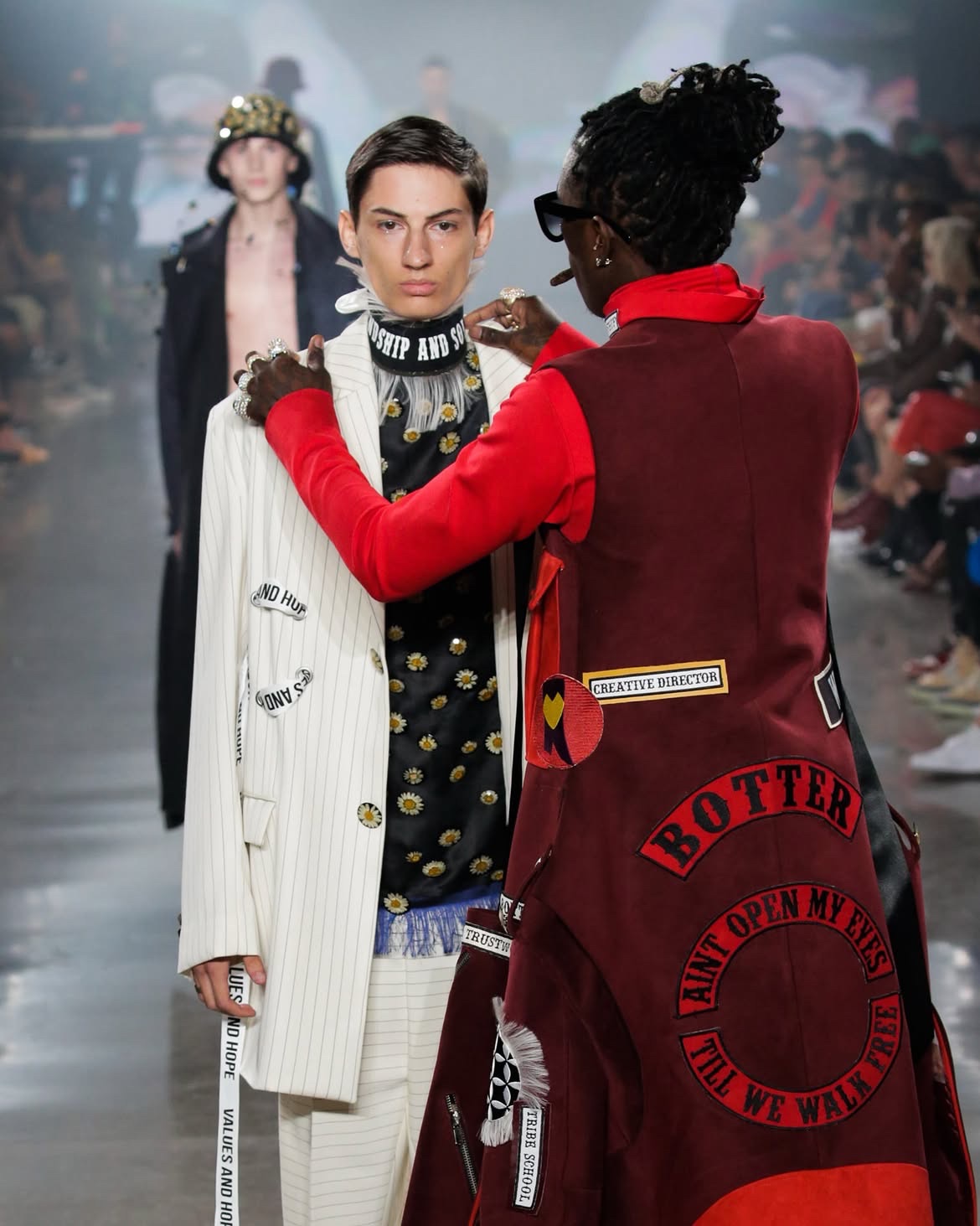
Young Thug became the clearest symbol of that overlap. He was not brought in simply to sit front row. He was one of the mentors, and during Rushemy Botter’s presentation he stood up, stopped a model walking past him and adjusted the collar of the look before letting him continue. Thug himself was wearing Botter that night. The moment collapsed the normal distance between celebrity guest, stylist, mentor and participant, which made it feel almost perfectly suited to VFILES.
His connection to Alessandro Trincone carried even more weight. Shortly before Fashion Week, Young Thug had chosen one of Trincone’s designs for the cover of JEFFERY. The pale blue ensemble, built from cascading pleats and finished with an enormous Japanese influenced hat, became one of the most recognizable images of Thug’s career. VFILES footage documented him discovering the garment, pointing toward it and immediately connecting it to the project. Trincone was still an emerging designer who had studied in Italy and Japan, yet his work had suddenly become part of a major music release before his VFILES collection even reached the runway.
When the look appeared during Runway 7, Thug stood and watched Trincone’s collection from the front row, photographing parts of it with an iPad. Vogue described Trincone as arriving at the show already carrying a burst of internet fame because of the JEFFERY cover. Years later, the same ensemble would appear in the Museum of Fine Arts Boston’s Gender Bending Fashion exhibition, giving an institutional afterlife to a garment that had first spread through music and the internet.
That sequence explains VFILES better than almost anything else. A young designer makes something strange and specific. An artist finds it through a fashion platform. The image travels across music and social media. Days later, the designer is showing during New York Fashion Week in front of many of the same people who helped circulate it. VFILES did not separate discovery, celebrity, community and runway into different stages. It allowed them to happen almost simultaneously.
The platform was also arriving at a moment when the definition of fashion authority was changing. Rappers were no longer only being dressed by established houses. They were introducing unknown designers to millions of people and developing relationships with clothing that could influence how an entire generation dressed. Streetwear was moving closer to luxury, gender boundaries were becoming more openly questioned in mainstream fashion, and online visibility could create relevance long before a designer had a traditional retail network. Young Thug’s relationship with Trincone made all of those shifts visible at once. Vogue later described Thug’s JEFFERY image as part of a wider change in male hip hop style toward increasingly experimental approaches to clothing.
VFILES was not without contradictions. It positioned itself against older forms of gatekeeping while still selecting who received its runway, mentors and resources. Vogue’s review of Spring 2017 also questioned whether the group show had enough cohesion, arguing that the spectacle sometimes outweighed a fully resolved collective statement. But that lack of uniformity was also central to what VFILES had become. It was not a fashion house trying to communicate one aesthetic. It was a platform trying to identify what was happening before those ideas became obvious to the rest of the industry.
Looking back, many of its methods no longer seem unusual. Designers are discovered through posts and reposts. Musicians can bring an unknown label to an international audience with a single image. Runway shows operate as content events as much as industry appointments, while the boundaries between fashion, music, art and online culture have become increasingly difficult to separate. VFILES recognized that shift early and built a physical system around it.
Spring 2017 matters because it caught that transition while it was still unfinished. Botter, Ground Zero, Song Seoyoon, Sánchez Kane and Trincone were not presenting one vision of the future. They represented several possible futures existing beside one another, while Young Thug, Playboi Carti, Naomi Campbell, Pat McGrath and the VFILES community connected those ideas to a wider culture.
VFILES was supposed to be an alternative to the institution. By Spring 2017, it had become an institution of its own, one built around the idea that the next important voice in fashion could come from almost anywhere, as long as someone was willing to look.